

| Elementary School
Primary 1 (Age 5) to Grades 5 (Age 10-11)
Introduction
Lincoln Elementary School enrolls approximately 100 students in
Primary 1 (kindergarten) through Grade 5. It has a special niche
on the Lincoln campus with its own playground and a schedule distinct
from Secondary School. At Lincoln, our goal is to develop potential
- intellectual, physical, social, and emotional - using a methodology
that nurtures each child’s learning style, personality,
talents and cultural heritage.
A certified and experienced classroom teacher leads each class
of approximately twenty children. In addition, we offer specialist
teachers for pullout programs in art, computer, library, music,
Nepal Studies, physical education, and English as a second language.
The varied program and abundance of activities help us to foster
growth of "the whole child" and provide each child with
many adult mentors.
 |
Highlights
•
Small classes
• American curriculum with many enrichment activities
• Commitment to meeting the needs of each individual child
• Specialist teachers for Art, Music, Physical Education,
Computers and Nepal Studies
• English as a Second Language (ESL) Specialist
• Learning Specialist/Resource Teacher providing diagnostic
assessments and instructional strategies for students with special
needs.
• School Guidance Counselor who works with teachers, students,
and families
• An environment which models caring and respect
• Library with extensive elementary collection where students
have weekly classes with a trained librarian
• Developing Capable People: a program which helps students
develop interpersonal skills
• Extensive after
school program: with art, music, drama, and sports
activities
 |
Global School Approach
More than
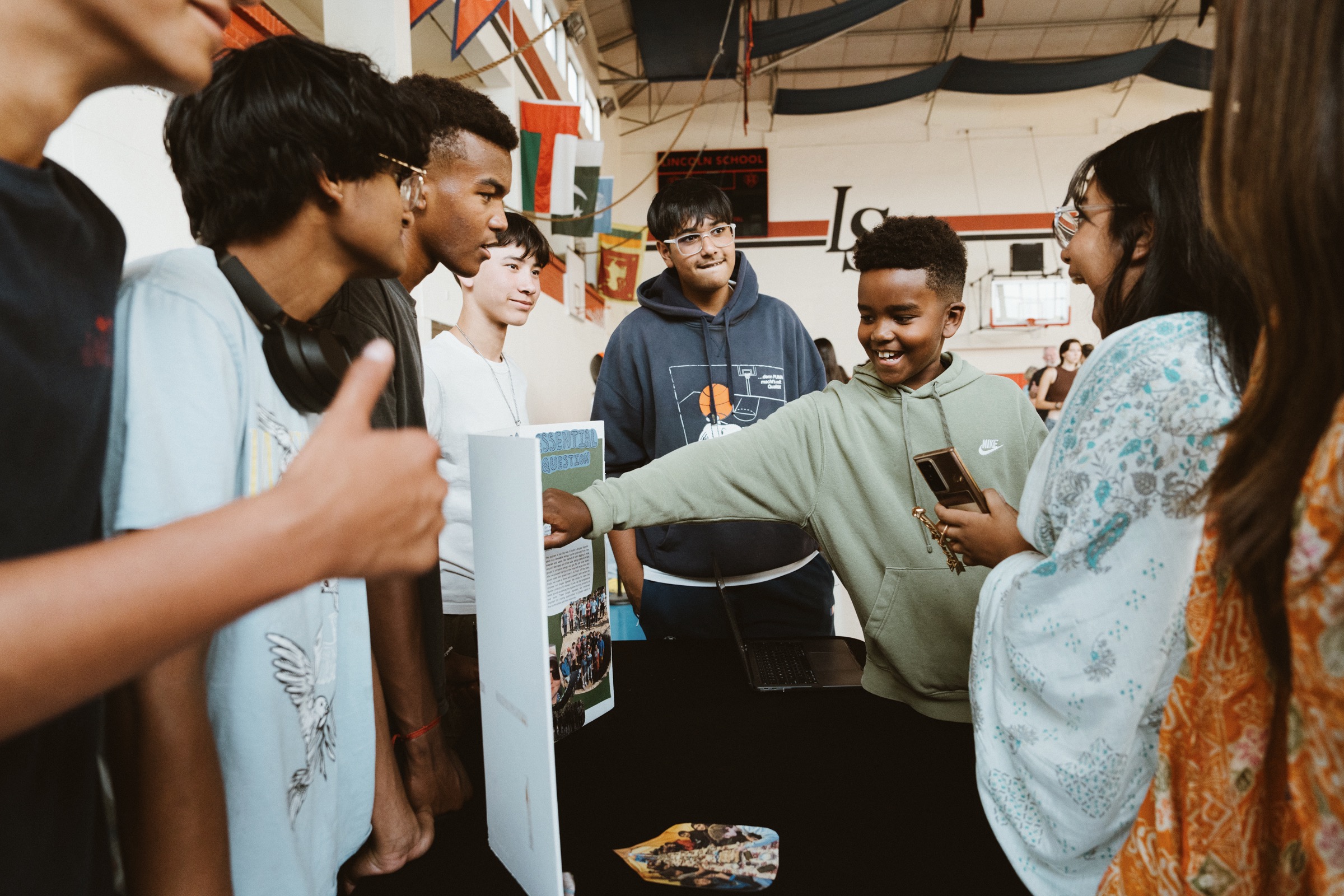
thirty countries are represented in Lincoln’s student body.
We value the positive impact on learning, cross-cultural awareness
and the development of life-long global friendships. Children
of every part of the globe have the opportunity to share their
native cultures and costumes in classroom V.I.P. events and through
monthly cultural presentations. Lincoln School has a flag to represent
every student’s country, and learning about the flags forms
part of our UN Day celebration.
We welcome students for whom English is not their first language.
An ESL teacher supports students in gaining English fluency.
As we develop our mini-global community, we also look to our
host country with a Nepal studies program, field trips, and a
trek for fifth graders.
Curriculum
In the Elementary
School the core curriculum includes language arts, science, math,
and social studies. Children are provided with a variety of challenging
and developmentally appropriate learning experiences designed
to make learning fun and meaningful.
Because of our small size and commitment to the individual child,
we give priority to learning about our students’ unique
gifts and special needs. There is a high level of collaboration
among teachers in developing appropriate support and enrichment
for each student. Our professional staff respects the uniqueness
and worth of each student and views differences as opportunities,
not disabilities. We are flexible in our teaching methods and
curricula. We aim for an "optimal match" approach that
accommodates the gifted student, the student with special learning
needs, and the varied learning styles of all students. We believe
that a school will benefit from the inclusion of students with
special gifts and talents as well as special needs, from diversity
and richness in teaching modes within the classroom, and from
the greater understanding of teaching and learning which accompanies
attention to differences.
Lincoln
offers on-site diagnostic assessments by a certified learning
specialist and pull-out programs where beneficial for
learning differences and English acquisition. For the child with
learning differences, a partnership between home and school, including
active commitment from the student, is necessary. Because we have
a diverse school population, there is decreased pressure for all
students to be exactly the same in achievement, culture and interests.
Students, too, contribute to the development of their peers as
each one strives for success and fulfillment.
 |
Program Descriptions
Language Arts: The primary goal of the language
arts curriculum is to develop a positive attitude toward reading
and writing using literature and authentic writing as the foundation.
Students are given the opportunity to read, write, listen and
discuss ideas every day in a meaningful context related to their
experiences, abilities and interests. In lower elementary, our
goal is to establish reading as the act of comprehending rather
than merely the act of decoding. Class libraries, shared literature
study, individualized reading, sustained silent reading, thematic
study of literature, journal writing and writing for publication
are coupled with a study of phonics and selected use of basal
reading and spelling texts. At upper elementary, greater emphasis
is placed upon thematic integration of the curriculum for reinforcement
and holistic expansion of language acquisition and skills with
the goals of improving the quality of reading comprehension, developing
a variety of reading strategies and increasing the range of voluntary
reading.
6+1
Trait Approach to teaching writing: We use the 6+1 Trait
Approach throughout the school which means that language and expectations
are consistent as we teach students to write. This approach identifies
five key aspects of writing: Ideas and Content, Organization,
Voice, Word Choice, Sentence Fluency, and Conventions. The +1
is Presentation. Each dimension of writing is accompanied by clear
rubrics which guide children in understanding what is expected
and in assessing their own work.
Mathematics: Problem solving provides the cornerstone
of our mathematics program. In solving problems, students are
given the opportunity to organize data, interpret information,
make decisions and think mathematically enabling them to function
effectively in today’s world. In mathematics, students gain
increasing competency in math algorithms: addition, subtraction,
multiplication and division of whole numbers, fractions, percents
and decimals. Throughout the Elementary School, emphasis is placed
on using manipulatives and real life experiences to understand,
develop and apply math concepts. The Everyday Math program is
used from primary 1 to grade 6.
Science: The objective of the science curriculum
is to expose children to the wonder of science and the joy of
discovery through inquiry. At each grade level, students use "hands
on" activities and laboratory experiments to develop competence
in the scientific process and to develop understanding of basic
concepts in earth and space science, life science, technology,
physical science and the human body.
Social
Studies: In the social studies curriculum, emphasis is
placed on the development of an understanding of humankind beginning
with the individual and expanding to world citizenship. Historical,
geographical and social concepts are developed as students progressively
broaden their horizon from family, home and school to the local
neighborhood, Nepal and finally to other worlds - the Age of Exploration
and American history through the revolution. We have established
a simulated economic community, Leopardstown, to convey concepts
in economics and civics. Students hold jobs, earn a salary, run
stores, a bank and a news paper and develop businesses. Leopardstown
is governed by a town council.
Click
here for details
of the science and social studies curriculum
Materials and Resources: click
here for a list of the programs and materials used
to support the core curriculum.
Go to top
Developing
Capable People: We give focus to affective development
through a program called "Developing Capable People".
Students are helped to understand the sources of misbehavior,
how to solve problems, and how to participate in class meetings
held to resolve conflicts, plan events or talk about issues of
importance. Teachers model a warm, caring approach as they interact
with children, believing that to show respect and love to a child
is the best way to teach these values.
The goal of this program is to develop in students self confidence
and skills to manage their behavior and develop positive social
relations with others. Students are helped to understand the sources
of misbehavior, how to solve problems and how to participate in
class meetings held to resolve conflicts, plan events or talk
about issues of importance. Books about this program are available
in the library.
Enrichment Curriculum: As enrichment to our
core classroom instruction, we offer weekly or twice weekly classes
taught by trained specialists. During the course of the week,
your child will attend classes in music, art, physical education,
computers, science, Nepal Studies and library studies. In addition,
some children will meet with the ESL teacher or learning specialist
who provides extra support where needed. A description of enrichment
classes is as follows:
Computer
Science: Elementary students attend weekly classes in
the computer lab. Lessons emphasize basic operational procedures
and specific applications which demonstrate a multitude of computer
related skills for developing competent, literate computer users.
Students also have easy access to computers throughout the school
to use as tools for classroom and individual projects.
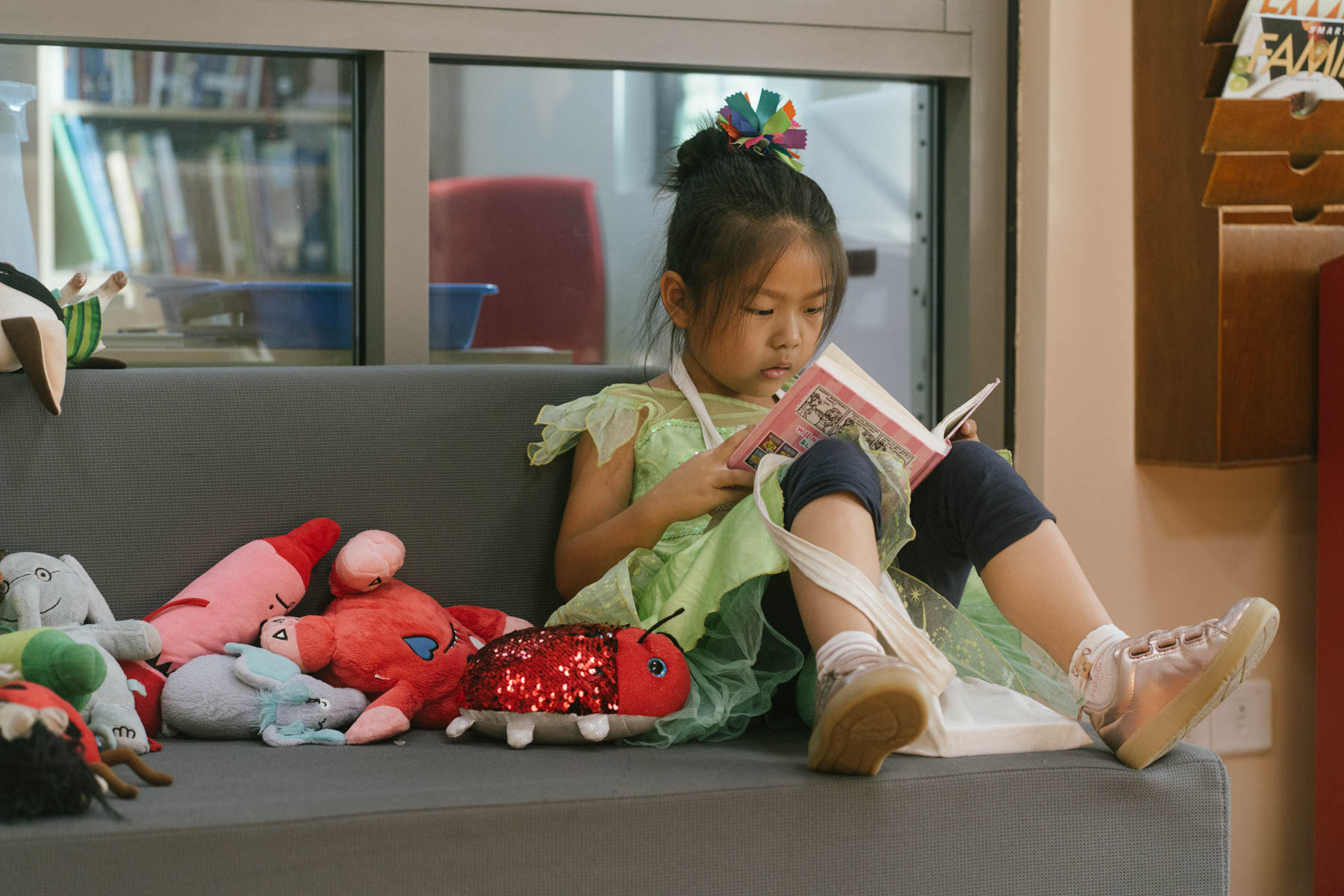
Library Skills: Lincoln’s library consists
of more than 22,000 volumes of fiction and non-fiction catering
to all age levels and interests. The print collection is supplemented
by two audio-visual centers with 700 educational videos, fifty
current periodicals and newspapers, and a computer research access
area. The library is seen as the core of our instructional materials
collection; consequently, we believe that instruction in its use
and encouragement of its enjoyment are vital to our overall educational
goals and objectives. Elementary students visit the library weekly
for storytelling, instruction in library skills and the opportunity
to borrow materials.
Art:
In the school’s art studio, elementary students explore
satisfying and interesting art experiences, learn basic skills
and art concepts, and expand the creative, fantastic and playful
parts of their selves. They learn to appreciate art forms and
artists of various cultures and are given opportunities to interpret
their experiences using a variety of media and techniques. The
program’s goal is to develop within our students a lifelong
interest in and appreciation for the fine arts and a positive
attitude toward their own creative self-expression.
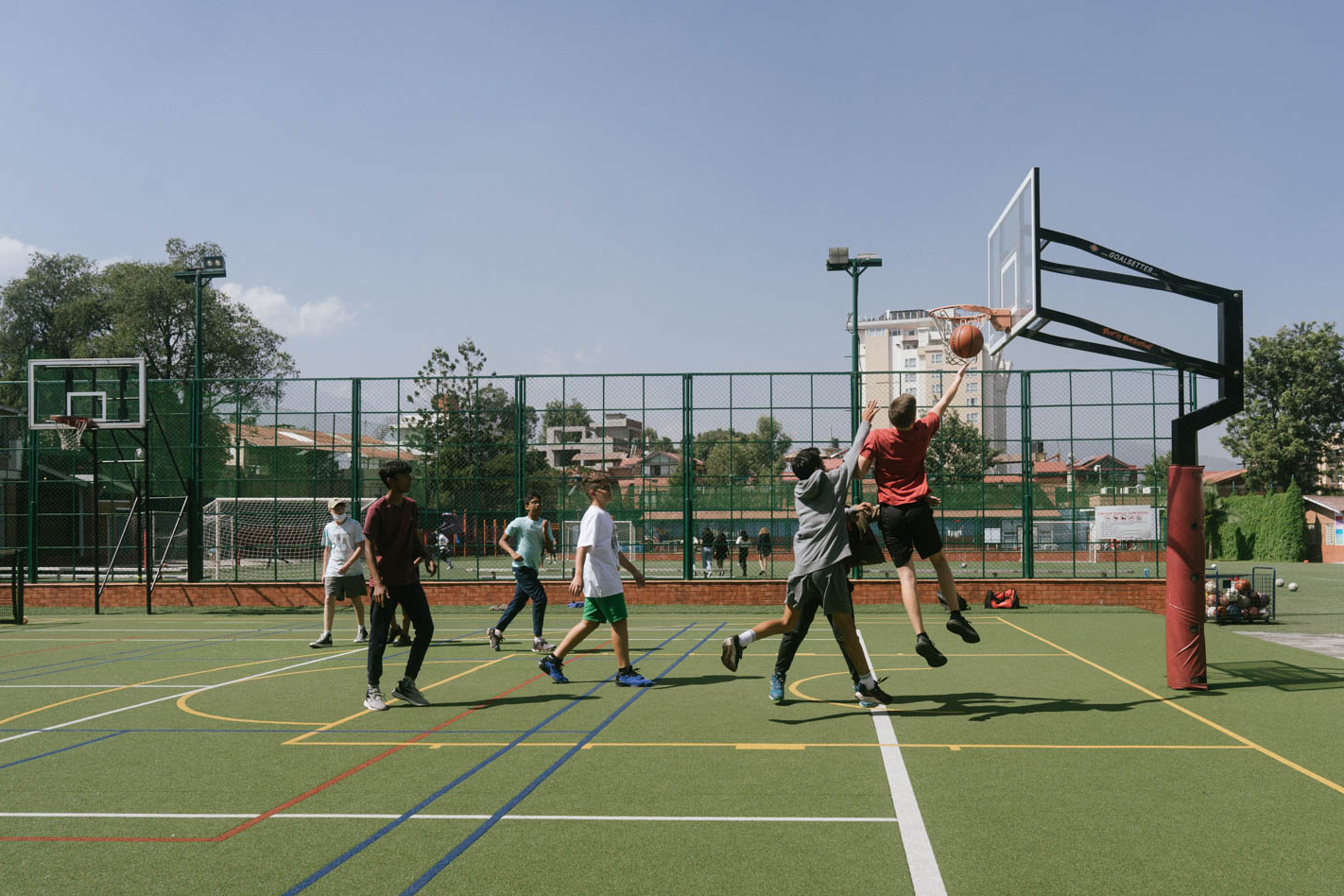
Physical Education: The elementary physical
education program is based on a movement-education approach. The
action-oriented classes are designed to stimulate creativity,
problem solving, self-confidence and physical development. The
program includes swimming, exploration with small hand apparatus
such as balls/ hoops/ ropes/ wands, activities in gymnastics,
rhythm and dance, track and field, and games. Please
click here for more information.
Music: With its aesthetic qualities, music provides
many experiences to help the child acquire independence, a positive
self-concept, a sense of responsibility and a realization of how
music correlates to the world around him. The music program is
a sequential, skills-oriented, participatory program which includes
singing, listening, playing instruments, creating, moving and
writing. Music classes are offered twice weekly although every
day begins with singing at morning assembly. Please
click here for more information.
Nepal Studies: Students meet twice weekly with
an experienced Nepali teacher to learn about the language, geography
and culture of our host country. Students come to appreciate and
understand Nepal as they try out traditional arts and crafts,
dance and sing, enact folk tales, participate in colorful festivals
and explore Nepal’s magnificent geography first hand.
After
School Activities: For a small school, Lincoln has rich
and varied extra-curricular programming, allowing students to
develop talents and new interests. Activities are offered quarterly,
and a student can take as many as five activities in one week.
Examples of activities are guitar or mandolin, knitting, gymnastics,
cooking, drama, painting, crafts, choir and martial arts. Activities
are taught by teachers, parent volunteers or outside instructors.
Courses taught by outside instructors, such as guitar, require
a fee to be paid by the student.
Other activities are available in the after school program. Cub
Scout and Girl Scout programs are offered if there is parent support,
as well as seasonal leagues in soccer and swimming. Girls and
boys with a theatrical bent can become school mascots as Pom Pom
Girls and Leaping Leopards or participate in a school drama production.
Bus transportation is available for students involved in these
after-school activities.
Report Cards: Report cards are issued three
times a year in P1 through grade 5. The report cards seek to convey
not only what your child is expected to learn but also the degree
of proficiency obtained. Students' general social and academic
skills are assessed along with progress in academic subjects.
Developmental continuums have been developed for P1 through grade
5 which outline the skills students will develop in the areas
of math, reading, and writing as they move through the elementary
grades. Recognizing that each child develops at a unique pace,
these continuums allow teachers to track where students are through
continuous assessments and what skills they need to learn next.
These continuums have been incorporated into the reporting process
and will be explained by the teacher at "Back to School"
morning. There are also two parent-teacher conference times, one
in the fall and one in the spring.
Go to top
Special Events
Throughout the year, there are special events which enrich the
academic program and create a sense of pageantry for the Elementary
School. Some favorite events are described as follows:
Fabulous
Friday: Every Friday morning, elementary students are
joined by their parents to open the day with an assembly. Children
practice being on stage and speaking before an audience as their
class performs for their families and school.
Morning Assembly: Every morning, the entire
elementary school gathers outside for announcement and review
of plans for the day’s events. Birthdays are recognized
and new arrivals and parting students are given special acknowledgment.
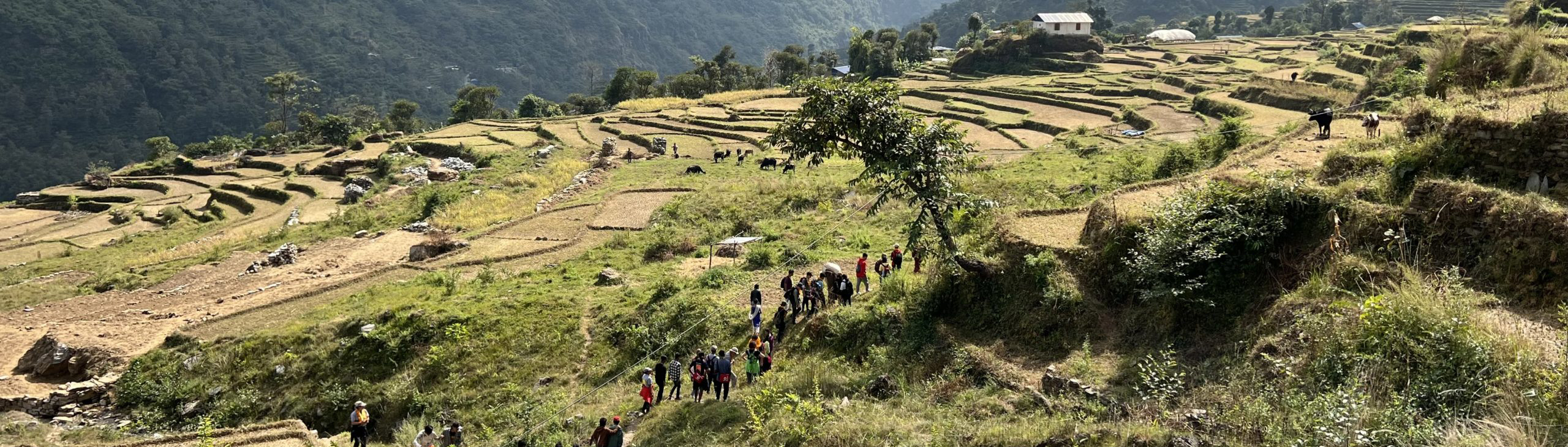
Explore Nepal: This begins in fifth grade. Small
groups of students, along with teachers and adult volunteers,
explore a village and school within the Kathmandu Valley for 4-5
days. Students are given the opportunity to study the lifestyles
and culture of the people of Nepal as well as its spectacular
geography in an unforgettable firsthand experience. These activities
strengthen students’ self-esteem and ability to work as
a team.
Kaleidoscope: While fifth graders are away on
Explore Nepal, Primary 1 through fourth grade classes change pace
with a week of "mini courses" and a day-long trek. The
multi-aged activities use a thematic, integrated curriculum approach.
Students and teachers from different grades get to know each other
as they explore creative learning activities.
United Nations Day: One of the most momentous
ceremonies at Lincoln is the United Nations Assembly held on or
near U.N. Day. The entire school gathers in native costumes beneath
each country’s flag. It is a day of celebrating the mission
of the U.N. and the diversity within our community.
Go to top
Testing
Lincoln faculty and administration monitor student progress and
adjustment through a Child Study Team approach, utilizing our
on-site diagnostic testing service, guidance counselor, learning
specialist, and resource program. In the Spring, The IOWA Test
of Basic Skills is administered in grades 3-8 and the Educational
Records Bureau's (ERB) writing assessment test in grades 3 through
5.
Your Child’s Day
The school day begins at 8:00 with an informal outdoor morning
assembly. Students have a morning recess and lunch from 12:20
to 1:05. (Students bring their own lunch from home or may order
from menus of selected restaurants.) Most of the child’s
day is spent in the classroom with a teacher and assistant. Approximately
two additional enrichment classes of 45 minutes, such as computer,
library, music, etc., are scheduled each day. The day concludes
at 2:30 for Primary 1 and first grade with after- school activities
available to 3:10. For second through fifth grade, the day concludes
at 3:10 with after-school activities offered from 3:15 to 4:00.
Go to top
Conclusion
At Lincoln we believe that the process of learning and the atmosphere
in which education is offered are as important as the end product.
The Lincoln faculty and administration are dedicated to providing
your child with an early education which will build an academic
and personal foundation for success in life. We hope that you
will allow us the opportunity to teach your child during these
formative years.
Kids’ Comments
"When you come to Lincoln School and you are alone, somebody
will come and say , "‘Do you want to be my friend?’
" Third Grade, Ethiopia
"Each year in Nepal flies by and my love for Lincoln grows
more and more. A student in ninth grade still plays with a second
grader. I think of it as a marvelous place." 5th Grade, USA
"I like our small classes because everyone has a chance
to join in and learn." Switzerland
"Lincoln School is like one big family. All the teachers
and students help you." Ireland
Go to top
|