



|
Introduction
Description
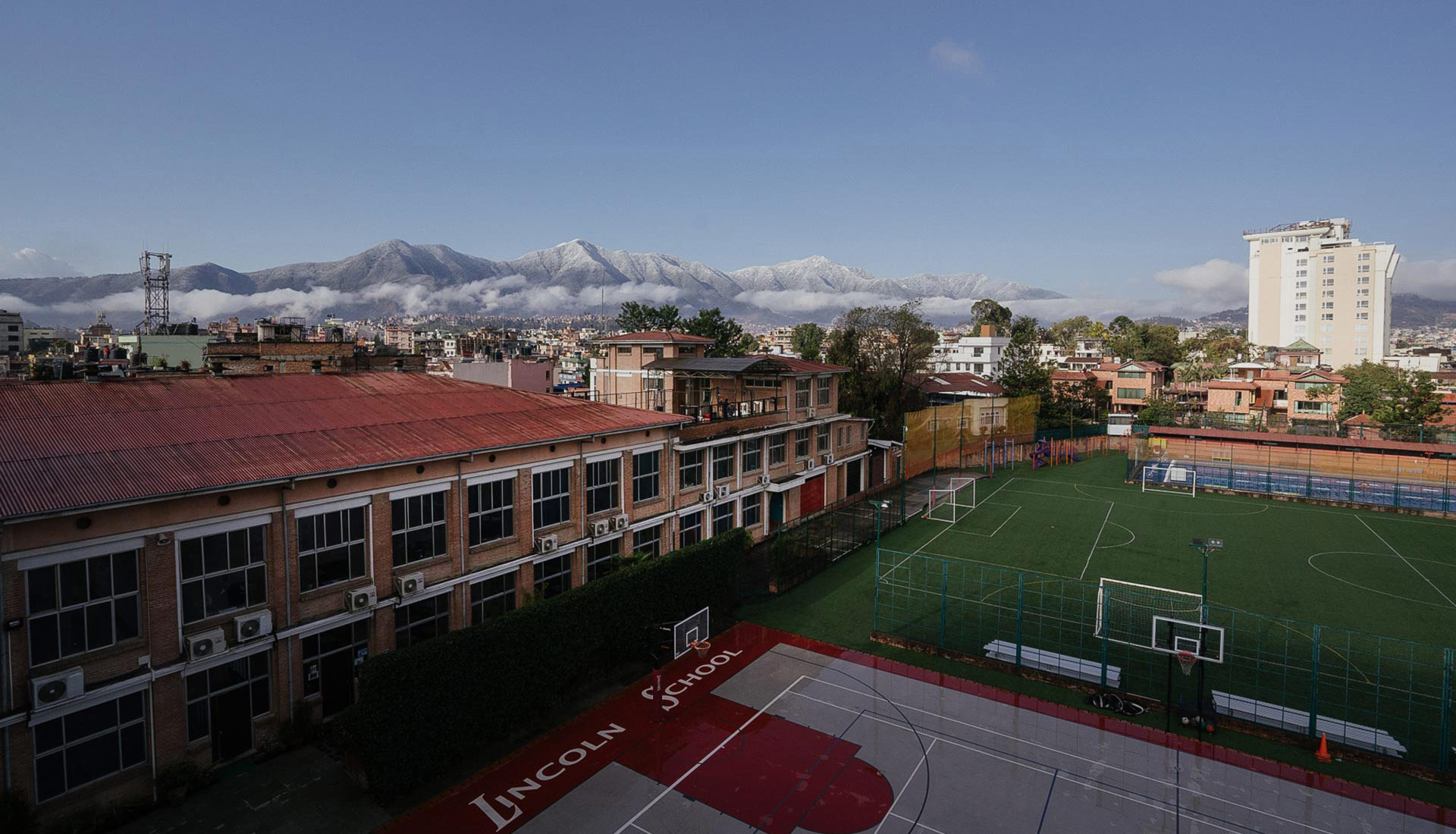
Lincoln School,
founded in 1954, is an independent, co-educational day school
for students of all nationalities in Preschool through Grade 12
and is governed by a nine-member School Board of Education. Lincoln
is fully accredited by the New England Association of Schools
and Colleges.
The school enrolls approximately 300 students. Lincoln School
offers an American curriculum with special programs in ESL, learning
resources, physical education, music, art, French, and Nepal Studies.
There is a full time nurse and a guidance and counseling program.
The campus also houses an 22,000 volume library, two computer
labs, theater, and gymnasium. Internet access is available at
the 130 networked workstations across the campus.
Mission Statement
Lincoln School is an independent, international school in Kathmandu,
Nepal with an American Curriculum. We are committed to:
N urture
of the individual student
E xcellence in all
spheres of achievement
P ursuit of personal
responsibility
A ppreciation of
diversity, and
L ove of learning
Vision Statement
We, the Lincoln School Community, see our school as a place of
scholarship and learning, a place of laughter and a place of diversity.
May this school always be a refuge from conflict, hatred, prejudice
and discrimination as people of all ages, cultures, races and
religions come together with respect, tolerance, and understanding.
May all who pass through these doors leave with an appreciation
of Nepal, a life-long love of learning, and a commitment to use
their knowledge and skills for the betterment of the world. May
the friendships and values developed here endure life’s
challenges and the test of time.
Go to top
Core Values
Nurturing of the individual student
Lincoln School provides a safe and caring environment that allows
for the nurturing of the individual student. It is an environment
in which patience and understanding allow the talents and capabilities
of each student to be developed. Students can be assured of support
emotionally as well as educationally as they develop their confidence
and self-esteem, and build a coherent set of values.
Excellence in all spheres of achievement
Lincoln School believes that curriculum should be demanding and
challenging. A demanding curriculum is one based on recognized
standards, enables our students to do well on external exams,
and expects our students to demonstrate learning through assessments
that the community agrees are demanding. A challenging curriculum
is one that recognizes that each learner is unique. Therefore,
a challenging curriculum expects each student to exceed his/her
current level of competence, to explore, to take risks, and to
think in complex and creative ways that lead to deeper understanding
of important ideas.
Pursuit of personal responsibility
Lincoln School believes that taking personal responsibility requires
actions and commitment by both students and the school. Students
should commit to abide by the Honor Code, respect the core values
of the school, and accept responsibility for their own decisions
and actions. They should feel free to seek out teachers and others
when they do not understand; should be encouraged to take initiatives;
should not blame others for their own failures and inadequacies;
and should be able to recognize and take steps to rectify those
failures and inadequacies. On its part, Lincoln School should
be prepared to delegate more responsibility to students while
recognizing that setbacks and failures will occur.
Appreciation of diversity
Lincoln School-a diverse community with students from over 40
countries, with different personalities, learning styles, skills
and knowledge-is committed to providing an environment of acceptance
of all and to inspiring unity in diversity. Accepting our diversity
means recognizing cultural, personality and intellectual diversity,
and working together in ways that that take advantage of our diversity
to enrich our learning opportunities.
Love of learning
Lincoln School’s larger goal is to generate in all students
a life-long love of learning. It recognizes the special challenges
faced by Lincoln’s many ESL students. Love of learning is
that level of passion that self-motivates students to explore,
be creative, take risks, be curious, and question personally his/her
own learning and not just absorb the teaching of others. When
there is a love of learning, learning becomes joyful, and both
an end in itself and a means to other ends. Love of learning assures
a commitment to life-long discovery.
Philosophy
Lincoln School, as a culturally diverse American international school,
aims to provide a challenging yet supportive learning environment
in which academic excellence is achieved through the recognition
of each student's learning style. We are aware of and respond to
our multi-cultural population by offering programs and activities
which address their needs and which complement our essentially American
curriculum. We believe that the process of learning is as important
as the end product. We aim to create a non-judgmental environment
which values freedom of expression in which ideas and opinions may
be examined openly and objectively.
Development
Therefore, our curriculum focuses not only on the acquisition
of knowledge, but also on the development of thinking and problem-solving
skills. We endeavor to teach students to read with understanding,
to write and speak clearly, and to reason scientifically and mathematically.
To do this, we encourage independence as well as cooperative group
work.
Lincoln develops World Citizens
In addition, we strive to provide students opportunities to
use their talents in as many aspects of school life as possible:
academic, social, athletic, and artistic. While we strive to cultivate
each student's individual imagination and creativity. Our larger
goal is to generate in all students a lifelong appreciation for
learning. We believe that for students to feel fulfilled and be
productive, they must demonstrate not only respect for themselves
and others but also assume responsibility for their decisions
and actions. Lincoln School aims to foster success and a sense
of compassion, and an understanding of their potential roles as
world citizens.
Education means partnership
It is our belief that education is an active partnership involving
faculty, administration, students and parents. Through our mutual
efforts, our students shall develop the skills and attitudes to
successfully meet the challenges of a rapidly changing world.
School
Board/Governance
Composition
The Board is comprised of nine members, elected from the parent
community by the Lincoln School Association for two-year terms
of office. Joined by five ex-officio, or non-voting, members --
the Director, a faculty representative, representatives of the
U.S. Embassy and USAID, and a Parent Organization representative.
Functions
The Board works in accordance with the Association's Constitution
and by-laws as well as within the parameters of its own detailed
Policy Handbook. Lincoln's Board brings diverse perspectives and
expertise to consideration of major concerns and developments
in the operation and long-range planning of the school, particularly
in the development of school policy and ensuring that policy is
carried out by the administration. In addition to its monthly
general meetings, the Board members form various standing and
ad hoc committees related to personnel, finance, education, scholarship,
buildings and grounds, emergency preparedness and marketing. These
committees also include administrative and faculty representatives,
interested parents, and an occasional outside specialist.
Minutes of the Meeting
Summaries of the monthly Board meetings are reported to the Association
by the Board Chairperson. Minutes of these meetings, to which
parents have an open invitation, are available from the school
office.
Student Body
Lincoln School expects an enrollment of approximately 300. Typically,
our student body represents some 35 nationalities. Most recently,
30% of our students were from North America, 28% from Europe, 20%
from the local Nepali community, and 22% from other areas of the
world.
The vast majority of expatriate students come from families who
are involved with international development organizations and
agencies. Children with parents attached to diplomatic missions
represent another significant group.
Go to top
|